



- Are These Symptoms a Sign of a Jammed Finger or Something More Serious?
- How Do You Know if a Jammed Finger Is Serious?
- Is a Jammed Finger and Broken Finger the Same Thing?
- How Is a Jammed Finger Diagnosed?
- Frequently Asked Questions (FAQs) About a Jammed Finger
- From the Fingertips to the Elbow, Fort Worth Hand Center Can Help
A jammed finger may be more serious if you notice deformity, severe swelling, numbness, or inability to move the finger. While many jammed fingers have mild ligament sprains, symptoms like these can indicate a fracture, dislocation, or tendon injury and should be evaluated by a hand specialist.
The probability is high that there will come a point in all our lives when we will suffer a jammed finger. It could be in the middle of football or basketball practice at school, while tripping and falling at the grocery store, playing fighting with a friend or sibling, or simply smashing one or two fingers against a piece of furniture or while a door is closing. It really is that common, and when it happens, the good news is that you did not break a bone. That said, the pain and throbbing are about all you can think about. It is easy to think that maybe—just maybe—it is not a jammed finger but rather something far more serious. But how do you know for sure?
These are valid questions. While it is true that jammed fingers happen far more often than fractures and make up most finger injuries, there is no telling in the moment what kind of damage was done when blunt force compresses your finger back toward your hand. For starters, the pain can often feel deceptively similar to a small fracture or even a joint dislocation, starting with pain, swelling, stiffness, and loss of mobility.
This is why it is important not only to monitor how the injury progresses but also to seek care from an orthopedic hand surgeon. It could just be a harmless jam that will take time to heal. But if it is a significantly jammed finger, or worse, and you leave it untreated, the road to recovery may take considerably longer.
Finger injuries can range from mild sprains to complex fractures, and proper diagnosis is essential to prevent long-term complications.
— American Society for Surgery of the Hand
Are These Symptoms a Sign of a Jammed Finger or Something More Serious?
- Mild to severe pain, swelling, and stiffness
- Sharp, immediate pain after impact
- Significant tenderness and bruising
- Inability to extend the finger fully
- Affected finger bent in an unnatural position
- Inability to move or difficulties moving the affected finger
- Mild to severe deformities
- Inflammation and stiffness
- Clicking or grinding sounds when you move your finger
- Numbness and tingling
- Pain that radiates into the hand
- General weakness
Jammed fingers are common, but persistent pain, swelling, or stiffness may signal a more serious injury.
— Cleveland Clinic
How Do You Know if a Jammed Finger Is Serious?
Because we use our hands, fingers, arms, and elbows for everything, there are so many ways we can put them at risk. A jammed finger is one of the most common examples of this. This occurs when the tip of the finger is forcefully pressed against the hand, resulting in an overstrained or stretched sensation that directly impacts the joints, ligaments, tendons, and surrounding tissue. Most of us think of athletes and jammed fingers in the same sentence, but anyone who has suffered a jammed finger will tell you it is not just athletes who get them. They can happen by accident, such as a fall, or even from your finger getting tangled and pulled awkwardly.
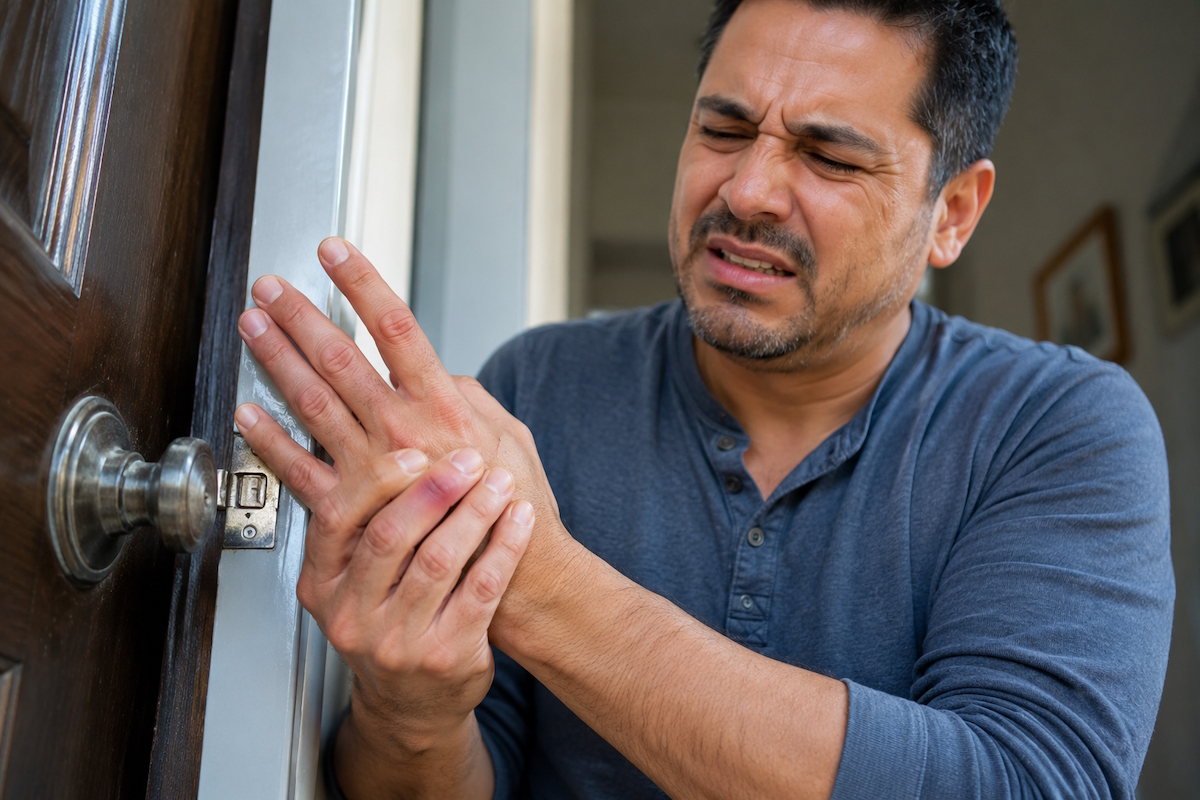
Like many injuries, a jammed finger has several grades of severity:
- Grade 1: The finger joint itself is still stable, but the ligaments within the injured finger have small tears in them. This causes mild pain, swelling, tenderness, and stiffness as you try to move your finger.
- Grade 2: In many situations, this presents as a partially torn ligament rather than a few smaller tears. You can still use the finger, but the pain is more intense, and your joint has minor instability issues.
- Grade 3: There is a complete tear of the ligament within the finger, and there is major instability.
If a finger is deformed or cannot move, it may indicate a fracture or dislocation and should be evaluated promptly.
— American Academy of Orthopaedic Surgeons
Is a Jammed Finger and Broken Finger the Same Thing?
When you are told you have a Grade 3 jammed finger, it is natural to consider that a broken finger. But that is not true. Broken fingers involve injuries to bones, while jammed or sprained fingers involve injuries to ligaments and soft tissues. With a broken finger, most people hear a pop, snap, or crack upon injury. They also experience severe pain that increases with movement. According to the American Society for Surgery of the Hand, the number of combinations of types and severity of hand fractures is infinite. The break could be tiny. Your individual pain tolerance may also not lead to any immediate symptoms. This is where proper diagnosis is so critical.
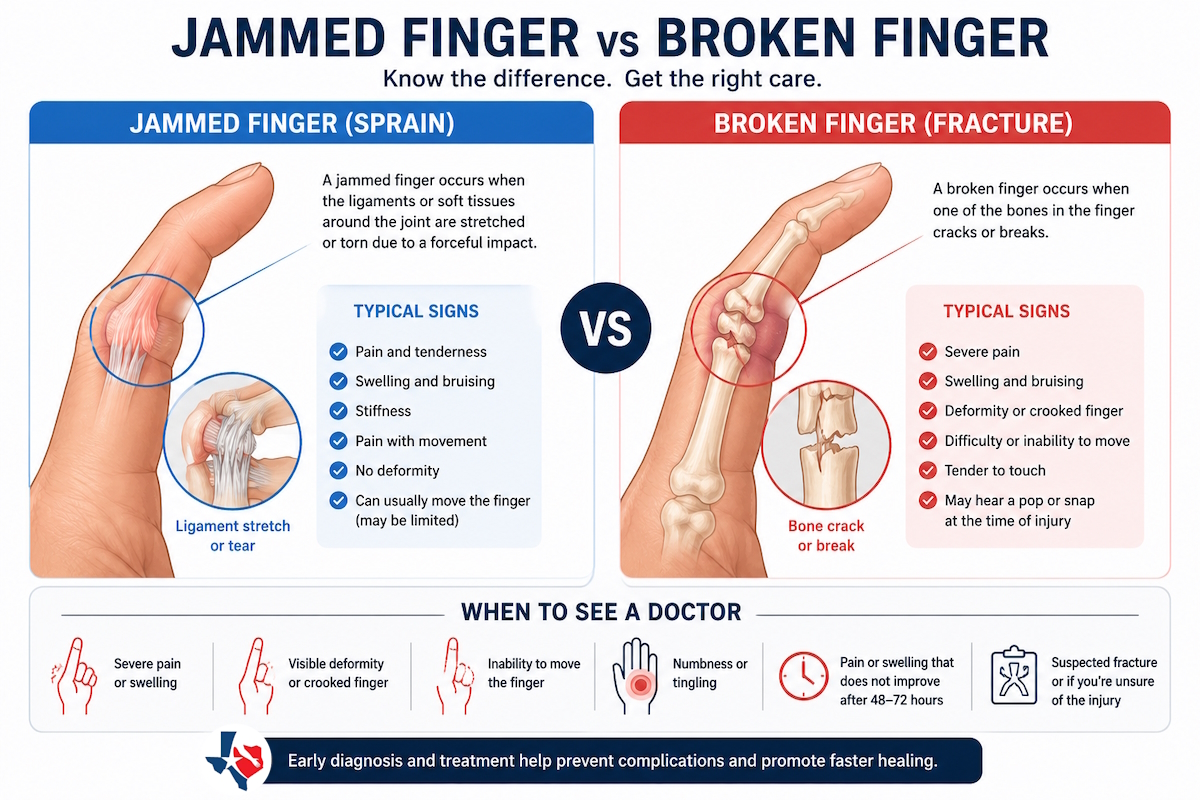
Here are a few additional signs that your jammed finger may be more serious and warrant a visit to the hand doctor:
- Finger deformity — If your finger looks crooked, bent at an unusual angle, or is misshapen, it is highly likely that you suffered a fracture or dislocation rather than a simple jammed finger. Finger deformities that are left untreated can lead to lingering pain, joint instability, and the likelihood that your finger will never work the same again.
- Numbness — Persistent numbness, tingling, or a complete lack of feeling or sensation in the affected finger may mean that a nerve has been injured or compressed in some way. Many people can’t explain why their fingers are numb. If you can, especially if it involves a recent injury or significant trauma, you need to be evaluated by a Fort Worth orthopedic hand surgeon. It is quite possible that the injury damaged nerves or blood vessels, and this is your body’s way of telling you that something is not right.
- Severe swelling — Almost any jammed finger will lead to persistent swelling and perhaps bruising. If your swelling does not get better or gets worse, it could be a sign of a fracture, torn ligament, or deeper joint injury.
- Color changes — To piggyback on numbness symptoms, it is possible that numbness could lead to color changes in the affected finger. If yours looks unusually pale or bluish, seek medical help immediately.
- Inability to straighten or bend the finger — With most jammed fingers, you can still bend your finger in some capacity. If you cannot bend your finger at all, it is likely that a broken bone is present.
- You’ve been told you have a Grade 3 sprain — If you have suffered a completely torn or ruptured ligament, this injury may require surgery to repair the torn ligament.
Jammed Finger Quick Self-Check:
1. Can you move your finger at all?
2. Does it look straight?
3. Is swelling improving after 24–48 hours?
If you answered “no” to any of these, it may be more than a jammed finger.
How Is a Jammed Finger Diagnosed?
To truly know if you have a jammed finger or something more significant, you must visit an orthopedic hand surgeon. This ensures a proper diagnosis and a catered treatment plan. The surgeon will start by examining your finger and asking you plenty of questions about how the injury occurred, your pain level, and your abilities.
Imaging tests, such as an X-ray, will then determine if you have a sprain or a broken bone. Depending on the severity of the injury, your hand doctor could also order an MRI.

Does visiting an orthopedic surgeon automatically mean surgery? No. It is possible that your jammed finger will simply need rest, ice, and compression, followed by physical therapy in some cases. Your doctor may also suggest splinting to keep your finger straight and allow for proper healing.
If surgery is needed, your hand doctor will walk you through the process, including explaining why this is the best course of action for your specific situation.
When to See a Doctor Immediately for a Jammed Finger
Seek immediate medical attention if you have:
- A visibly crooked or deformed finger
- Numbness or loss of sensation
- Finger turning pale, blue, or cold
- Inability to bend or straighten the finger
- Severe pain that worsens over time
Frequently Asked Questions (FAQs) About a Jammed Finger
From the Fingertips to the Elbow, Fort Worth Hand Center Can Help
Finger injuries, including jammed fingers, are a common condition that almost anyone can experience at some point in their life. The good news is that this condition does not have to interrupt the things you love to do or need to do for work. Finger pain of any kind is treatable, often through conservative means that you can perform at home. If necessary, your orthopedic surgeon may also recommend surgery if your situation is severe enough. If you want to reclaim your life, take the time to find the right orthopedic hand surgeon for your unique needs.
Jammed Finger Recovery Tip: Avoid “toughing it out.” Continuing to use an injured finger without proper support can worsen ligament damage and delay healing.
Fort Worth Hand Center surgeons are specialists in treating chronic conditions and traumatic injuries, as well as performing state-of-the-art complex microscopic nerve repairs and tendon transfers. Visiting an orthopedic surgeon can open the door to various treatment options to resolve or reduce your symptoms and get you back to living the life you deserve quickly and in the least invasive way possible. But before any of that happens, our goal is to conduct a thorough examination to determine the best course of action. Sometimes, it may be surgery. Other times, a more conservative approach is better.
If surgery is your recommended treatment, our orthopedic physicians operate in state-of-the-art, accredited surgery centers. To schedule an appointment, call 817-877-3277 or complete the form below.
"*" indicates required fields
Before starting any new treatment or if you have questions regarding a medical condition, always seek the advice of your doctor or other qualified health provider. This information is not a substitute for professional medical advice.
Fort Worth Hand Center serves the DFW area, including Richland Hills, River Oaks, Saginaw, Sansom Park, Southlake, Trophy Club, Watauga, Westlake, Westover Hills, Westworth Village, White Settlement, Arlington, Azle, Bedford, Benbrook, Blue Mound, Burleson, Colleyville, Crowley, Dallas, Dalworthington Gardens, Edgecliff Village, Euless, Everman, Flower Mound, Forest Hill, Fort Worth, Grand Prairie, Grapevine, Haltom City, Haslet, Hurst, Keller, Kennedale, Lakeside, Lake Worth, Mansfield, Newark, North Richland Hills, Pantego, Pelican Bay, and all of North Texas.
*Patient names and/or photos may be changed to protect patient confidentiality.