



- Do These Textbook Symptoms of Cubital Tunnel Syndrome Sound Familiar?
- What Causes Cubital Tunnel Syndrome?
- How Is Cubital Tunnel Syndrome Diagnosed and Treated?
- What Does Recovery From Cubital Tunnel Syndrome Look Like?
- Frequently Asked Questions (FAQs) About Cubital Tunnel Syndrome
- From the Fingertips to the Elbow, Fort Worth Hand Center Can Help
We’ve all said it: “I hit my funny bone.” But few of us know what that actually means, and even fewer expect it to be a cause for concern. Most funny bone moments come from an accidental bump—your elbow catches the edge of a desk or a doorframe as you walk by. What follows is a sharp jolt at the point of impact and a pins-and-needles tingling that runs down your arm. That discomfort usually fades quickly. But sometimes the nerve that runs along the inside of the elbow, called the ulnar nerve, becomes compressed or irritated, and those symptoms linger or gradually get worse. This is often a sign of a condition called cubital tunnel syndrome and trust us when we say it is no laughing matter.
Cubital tunnel syndrome is a condition in which increased pressure on the ulnar nerve at the elbow causes pain, numbness, tingling, and weakness in the hand and fingers. It is the second most common nerve compression syndrome after carpal tunnel syndrome, and studies estimate at least 25 new cases for every 100,000 people each year. If severe cases are left untreated, cubital tunnel syndrome can lead to permanent nerve damage. That is where early diagnosis and targeted treatment from a Fort Worth hand doctor can make all the difference.
Cubital tunnel syndrome is a cause for concern if you have persistent numbness or tingling in your ring and little fingers, or hand weakness that makes it hard to grip objects. While many cases improve with conservative treatment, persistent symptoms can signal significant nerve compression and should be evaluated by a hand specialist.
Do These Textbook Symptoms of Cubital Tunnel Syndrome Sound Familiar?
- Numbness in the ring and little fingers
- Tingling, especially when the elbow is bent
- Pain and tenderness on the inside of the elbow
- Hand weakness and decreased grip strength
- Frequently dropping objects
- Loss of finger coordination and dexterity
- Symptoms that worsen at night or while using a computer
- Increased sensitivity along the inside of the forearm
- Muscle wasting in the hand (in advanced cases)
If any of these symptoms sound familiar, keep an eye on how they progress and consider seeing an orthopedic hand surgeon. It could be a harmless funny bone bump that fades in no time. But if pain, numbness, or weakness persists and goes untreated, the road to recovery may take considerably longer.
“Did you know that your funny bone isn’t a bone? It’s a nerve.”
What Causes Cubital Tunnel Syndrome?
There are three main nerves in your arm: the median, ulnar, and radial nerves. The ulnar nerve runs from your neck all the way down to your hand. Along the way, it passes close to the surface of the bone on the inside of your elbow—the “funny bone”—and slides through a narrow passage called the cubital tunnel. Under normal circumstances, this tunnel protects the nerve and lets it do its job: controlling muscles and carrying sensation in your forearm, hand, and fingers. But with very little padding around it, this is one of the nerve’s most vulnerable spots.
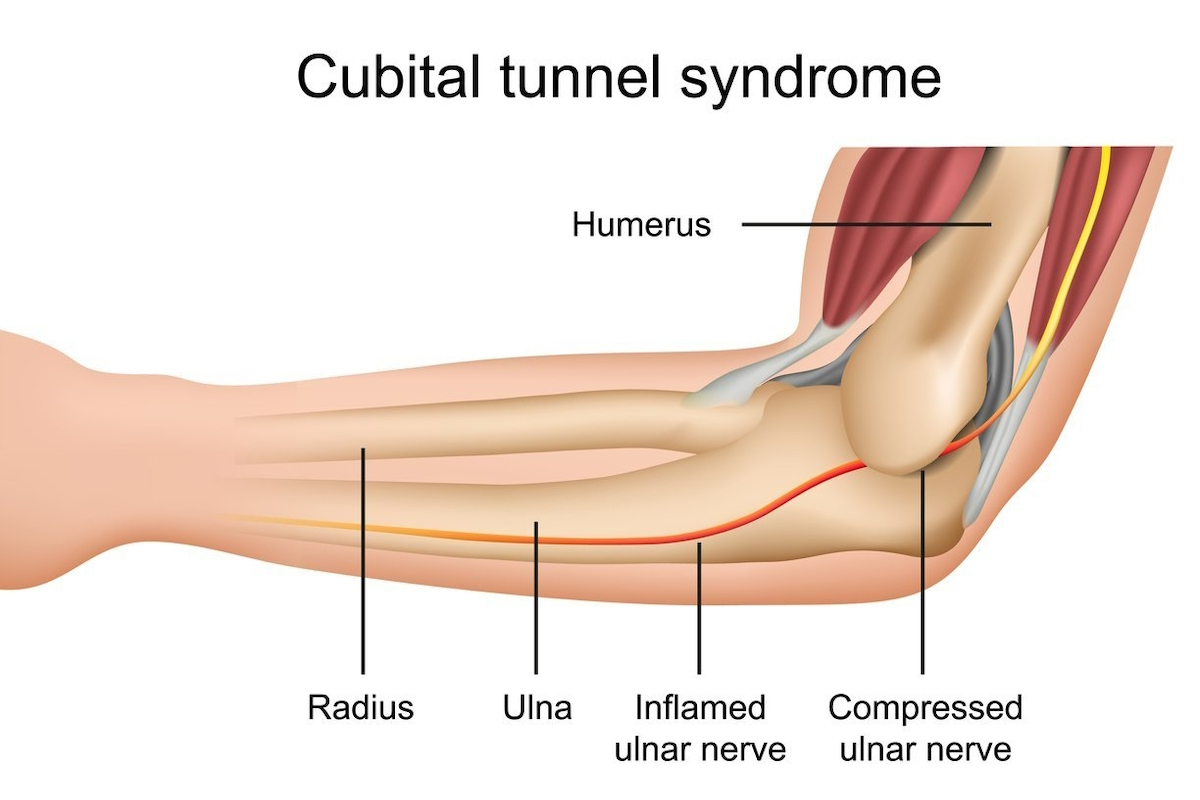
“The ulnar nerve is especially vulnerable to compression at the elbow because it must travel through a narrow space with very little soft tissue to protect it.”
As the ulnar nerve passes through the cubital tunnel, it can become compressed, pinched, irritated, or inflamed. Common causes and risk factors include, but aren’t limited to:
- Repeated or prolonged elbow bending — Keeping your elbow bent for long periods, such as while sleeping or talking on the phone, stretches the nerve and increases pressure on it. Leaning on your elbows on hard surfaces at work can also create problems over time.
- Repetitive activities — Sports that involve repeated elbow bending, gripping, and throwing, such as baseball, golf, tennis, football, and weightlifting, can contribute to cubital tunnel syndrome. So can carpentry, gardening, frequent use of power tools, and even long hours of typing.
- Past injuries or structural problems — Previous elbow fractures or dislocations, bone spurs, arthritis, an unstable ulnar nerve that snaps in and out of place when the elbow bends, and scar tissue from earlier elbow surgery can all put pressure on the nerve, in men and women of nearly any age.
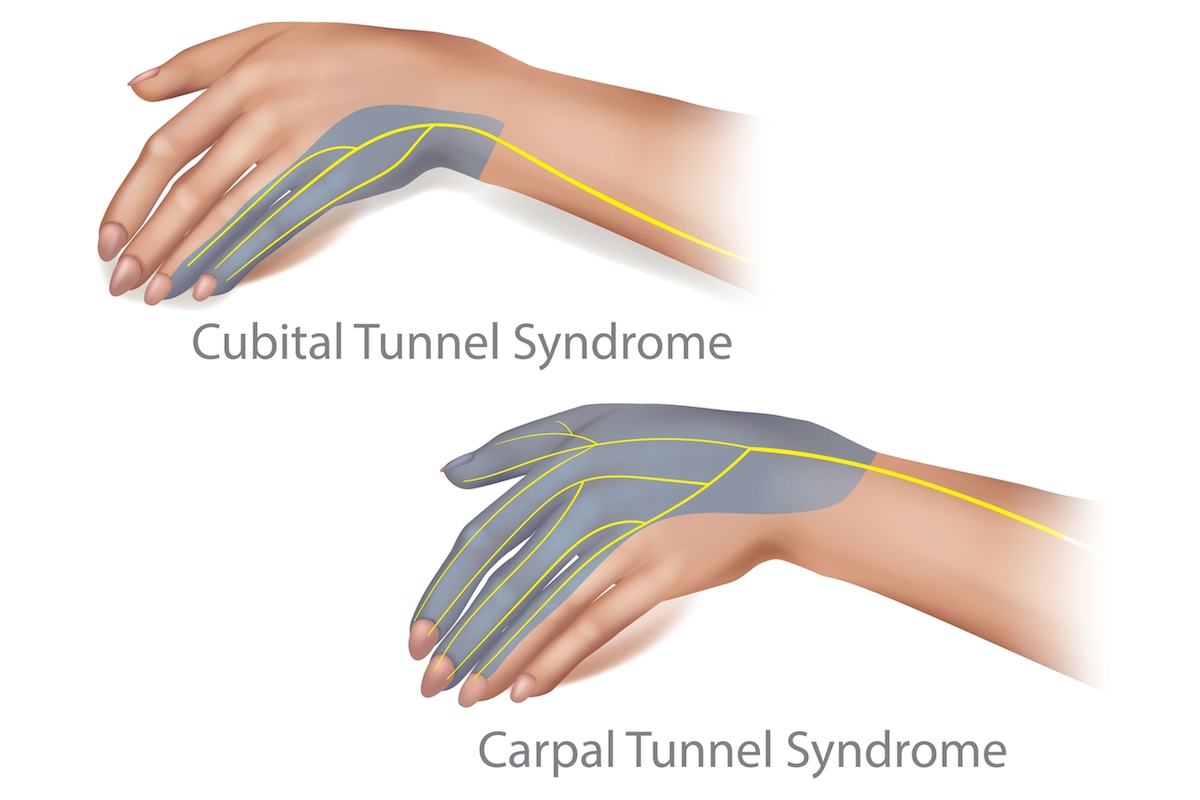
Cubital tunnel syndrome is often confused with two other conditions. Numbness and tingling that start at the wrist may come from compression of the same ulnar nerve farther down the arm, a separate condition called Guyon’s canal syndrome (also known as ulnar tunnel syndrome). Many people also mix it up with carpal tunnel syndrome. The key difference is the nerve involved.
Cubital Tunnel vs. Carpal Tunnel at a Glance
• Cubital tunnel syndrome: ulnar nerve, compressed at the elbow. Affects the ring and little fingers.
• Carpal tunnel syndrome: median nerve, compressed at the wrist. Affects the thumb, index finger, middle finger, and part of the ring finger.
How Is Cubital Tunnel Syndrome Diagnosed and Treated?
The first step is an accurate diagnosis. An orthopedic hand surgeon will ask about your symptoms, examine your elbow, arm, and hand, and check for weakness and loss of feeling. They may also order X-rays to look for bone spurs or arthritis, along with nerve conduction studies or an electromyogram (EMG) to see how well the nerve and nearby muscles are working and how severe the compression is.
Mild cases often improve with nonsurgical care, such as changing the activities that aggravate symptoms, wearing a padded splint at night to keep the elbow straight, avoiding leaning on the elbow, and hand therapy. Over-the-counter anti-inflammatory medications, such as ibuprofen, may help relieve pain and swelling around the nerve.
If those measures don’t help, the next question many people have is, “Will I need surgery?” Surgery is typically recommended when symptoms persist despite conservative treatment, when testing shows the nerve is severely compressed, or when muscle weakness develops. Your orthopedic hand surgeon may discuss options such as:
- Cubital tunnel release — The “roof” of the cubital tunnel is cut and divided to make the tunnel larger, relieving pressure on the nerve.
- Ulnar nerve anterior transposition — The nerve is moved from behind the bony bump on the inside of the elbow to the front of it, so it no longer gets stretched or caught on the bone when you bend your arm.
- Medial epicondylectomy — Part of the medial epicondyle (that same bony bump) is removed so the nerve can glide more freely.
The good news is that these procedures are usually performed on an outpatient basis, so most patients go home the same day. Hand therapy is often part of recovery to help you regain full motion and strength.

Cubital Tunnel Syndrome Quick Self-Check:
- Do you have numbness or tingling in your ring finger and little finger?
- Do your symptoms get worse when your elbow is bent for long periods?
- Are you noticing weakness in your grip or frequently dropping objects?
- Does shaking out your hand or straightening your elbow temporarily relieve your symptoms?
If you answered “yes” to any of these questions, your symptoms may be related to ulnar nerve compression and could be a sign of cubital tunnel syndrome. Persistent numbness, worsening weakness, or muscle loss in the hand should be evaluated by a medical professional.
Cubital Tunnel Syndrome Quick Self-Check:
• Do you have numbness or tingling in your ring finger and little finger?
• Do your symptoms get worse when your elbow is bent for long periods?
• Are you noticing weakness in your grip or frequently dropping objects?
• Does shaking out your hand or straightening your elbow temporarily relieve your symptoms?
If you answered “yes” to any of these questions, your symptoms may be related to ulnar nerve compression and could be a sign of cubital tunnel syndrome. Persistent numbness, worsening weakness, or muscle loss in the hand should be evaluated by a medical professional.
What Does Recovery From Cubital Tunnel Syndrome Look Like?
Recovery depends on how long the nerve has been compressed and how much damage has occurred. With nonsurgical treatment, many people with mild symptoms feel better once they avoid the positions and activities that irritate the nerve. After surgery, you may wear a splint or bandage for a short time before starting gentle exercises and hand therapy.
Be patient with the process. Nerves heal slowly, so numbness and tingling may take several months to improve, and grip strength can take even longer to return. If the nerve was severely compressed for a long time, some symptoms may not go away completely—one more reason not to wait to get help.

“Recovery can take many months. Nerves don’t heal as quickly as other parts of your body.”
Frequently Asked Questions (FAQs) About Cubital Tunnel Syndrome
From the Fingertips to the Elbow, Fort Worth Hand Center Can Help
We don’t realize how much our elbows do for us every day until something goes wrong. Many elbow bumps are minor and can be laughed off after a few days of ice, rest, and ibuprofen. But if you have numbness and tingling that won’t go away, or your grip isn’t what it used to be, you are likely dealing with a chronic issue that will only get worse with time.
Cubital Tunnel Syndrome Recovery Tip: Keep your elbow straight while you sleep. A padded night splint, or even a towel wrapped loosely around your straightened arm, can take pressure off the ulnar nerve overnight, when symptoms often flare.
Fort Worth Hand Center surgeons are specialists in treating chronic conditions and traumatic injuries, as well as performing state-of-the-art complex microscopic nerve repairs and tendon transfers. Visiting an orthopedic surgeon can open the door to various treatment options to resolve or reduce your symptoms and get you back to living the life you deserve quickly and in the least invasive way possible. But before any of that happens, our goal is to conduct a thorough examination to determine the best course of action. Sometimes, it may be surgery. Other times, a more conservative approach is better.
If surgery is your recommended treatment, our orthopedic physicians operate in state-of-the-art, accredited surgery centers. To schedule an appointment, call 817-877-3277 or complete the form below.
"*" indicates required fields
Before starting any new treatment or if you have questions regarding a medical condition, always seek the advice of your doctor or other qualified health provider. This information is not a substitute for professional medical advice.
Fort Worth Hand Center serves the DFW area, including Richland Hills, River Oaks, Saginaw, Sansom Park, Southlake, Trophy Club, Watauga, Westlake, Westover Hills, Westworth Village, White Settlement, Arlington, Azle, Bedford, Benbrook, Blue Mound, Burleson, Colleyville, Crowley, Dallas, Dalworthington Gardens, Edgecliff Village, Euless, Everman, Flower Mound, Forest Hill, Fort Worth, Grand Prairie, Grapevine, Haltom City, Haslet, Hurst, Keller, Kennedale, Lakeside, Lake Worth, Mansfield, Newark, North Richland Hills, Pantego, Pelican Bay, and all of North Texas.
*Patient names and/or photos may be changed to protect patient confidentiality.